
















ChatGPT burst onto the scene in late 2022, quickly changing how people search for and consume information. Since then, legal marketers have been exploring how to use the platform to gain efficiency, see around blind spots, and create leverage.
More users are turning to ChatGPT instead of traditional search engines to find services, compare providers, and make decisions. As adoption grows, the legal industry is well-positioned to benefit—especially with the introduction of ChatGPT advertising. This article breaks down what can be done now in regard to ChatGPT ads for law firms, what might be possible soon, and what law firms, managing partners, and legal marketers need to know.
What Are ChatGPT Ads?
ChatGPT Ads are currently invite-only and not widely available, but early signals suggest they will operate on a cost-per-mille, or thousand impressions, (CPM) model. While official pricing hasn’t been released, industry chatter points to a potentially high minimum monthly spend—possibly $200,000 or more. Early information suggests roughly $60 CPM. This is much higher than most ad platforms out there, where average costs range from $10 to $40 CPM on popular ad platforms like Google and Facebook (Meta).
This positions ChatGPT Ads as a compelling opportunity for mid-sized to large law firms looking to expand beyond traditional platforms like Google, Meta, and Bing. While the barrier to entry may seem steep, early indicators suggest strong conversion potential. Ads are expected to be prompt-based, meaning when a user searches “best PI lawyer in Vegas,” your firm’s ad could appear directly below the response—rather than relying solely on organic inclusion in the AI’s output.
Beta results remain largely under wraps, but one thing is certain: this is a platform law firms can’t afford to ignore. ChatGPT Ads should be viewed as a future pillar of a diversified media mix because the LLM revolution is here to stay and like Google it will only grow in popularity. ChatGPT usage as of now is roughly 400 mllion active users per week and projections suggest that will grow to 800 millon or more. (Some pundits believe it could surpass 1 billion as earl as this year!)
How Will ChatGPT Ads Work?
OpenAI has confirmed several foundational elements of how the ads work. At a high level:
- Ads appear after ChatGPT’s response, not within the response itself
- Ads are clearly labeled as “Sponsored”
- Ads are contextual, based on the user’s prompt
- Ads do not influence the AI’s answer
This design choice is intentional. OpenAI has emphasized that the integrity of ChatGPT’s responses is separate from advertising, with ads presented as an optional next step rather than part of the answer.
Who Will See ChatGPT Ads?
During the testing phase, ads are expected to appear for free-tier ChatGPT users, ChatGPT-Go subscribers, and adult users in the United States. Paid tiers such as Plus, Pro, Business, Enterprise, and Education are expected to remain ad-free, at least initially. Ads are also not shown in sensitive conversations, such as those involving health, mental health, or politics.
This means advertisers may gain access to a very large audience, while premium subscribers continue to enjoy an uninterrupted experience.
What Do ChatGPT Ads Look Like?
Ads are still rarely seen, but examples suggest they appear directly below ChatGPT responses and are clearly labeled as “Sponsored.” This keeps the experience transparent while maintaining high visibility within the conversation flow.
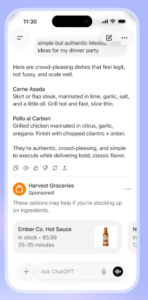
What You Need to Know About ChatGPT Ads for Law Firms: What it Means For You
ChatGPT Ads are coming, and preparation matters. Over the past few quarters, we’ve already seen strong organic referral traffic from major LLMs to law firm websites. Paid placements are expected to amplify this impact.
Law firms stand to benefit significantly from this new channel for several reasons:
- Legal searches are often complex and expensive. ChatGPT allows users to ask nuanced questions that signal strong intent.
- Early adopters may face less competition than saturated platforms like Google Ads.
- Law firms that present clear, helpful messaging align well with ChatGPT’s informational environment.
- Even before ads, many firms are already seeing referral traffic from LLMs. Paid placements could amplify this trend.
When Can Your Firm Advertise on ChatGPT?
There’s no confirmed launch date for broad commercial availability. What we do know is that ads are expected to appear for users on Free or Go plans—representing a large portion of the U.S. user base. Until ChatGPT Ads are fully live, Google remains the most accessible AI-driven advertising option. We’re already running AI-powered Google campaigns for clients with strong performance and meaningful returns.
Law firms that are ready to invest early may gain access to premium ad real estate before the platform becomes crowded. Early adopters often benefit from lower competition and stronger positioning—advantages that can be hard to reclaim later. An interim measure is Google AI ads.
How ChatGPT Ads Differ From Traditional Digital Ads
ChatGPT Ads are not just another version of Google Search or Meta Ads. They introduce several important differences:
- Prompt-Based Context Instead of Keywords: Rather than bidding on short keywords, ads are matched to full conversational prompts. This allows for deeper context and clearer intent.
- Fewer Distractions: There are no competing ads stacked above and below. When an ad appears, it has significant visibility.
- Mid-Funnel to Bottom-Funnel Intent: Users often ask ChatGPT questions after they’ve already done some thinking. This places many prompts closer to decision-making than top-of-funnel awareness searches.
- Trust-Based Environment: Users tend to trust ChatGPT’s responses more than traditional ads. While ads are clearly labeled, their proximity to trusted information increases their perceived relevance.
Targeting in ChatGPT Ads is expected to be primarily contextual, based on what the user is asking in the moment. This differs from platforms that rely heavily on demographic data, behavioral tracking, and retargeting history. Instead, relevance is driven by intent expressed in the conversation and topic alignment. This model favors advertisers with clear messaging and strong alignment to user needs rather than broad audience targeting.
What Can You Do Right Now?
When it comes to digital visibility, there’s always work to be done. Focus on strengthening your organic LLM presence. Continue producing high-quality, authoritative content that answers real client questions. This lays the groundwork for both organic visibility and future paid success.
Talk with your digital visibility agency partner about existing AI-driven ad options, particularly Google, and begin planning budgets with ChatGPT Ads in mind. When these ads launch broadly, speed will matter. Being first to market could be a decisive edge.
Helpful resources
Discover the power of effective digital marketing.
Sign up to receive 9Sail’s exclusive content and tactical tips, focused on helping law firms grow.
9Sail takes your privacy seriously and will only use your personal information to deliver communications you have requested of us. You can change your preferences at any time.