
















The most dangerous assumption in law firm management today isn’t about AI adoption, remote work, or associate retention. It’s this: “We don’t get clients from our website. We can catch up on digital later.”
Yes you do. And no, you can’t.
Digital infrastructure improvements create compounding returns that accelerate over time. Meanwhile, digital neglect creates compounding penalties that become exponentially harder to reverse. The firms making strategic digital investments today aren’t just pulling ahead—they’re creating advantages that will become impossible to overcome within five years.
This isn’t hyperbole. It’s the inevitable consequence of how digital authority actually works. 2026 is the last year when aggressive digital investment can close the gap within a reasonable timeframe. The firms dominating your market in 2030 are making their digital infrastructure investments right now. The firms struggling to compete are the ones convinced they still have time.
What Digital Leaders Are Actually Doing
The law firms building insurmountable advantages in 2026 aren’t doing magic—they’re executing five specific strategies consistently:
Practice-Specific Authority Architecture
Instead of generic “our firm handles business law,” they’re creating comprehensive content hubs for specific problems, like:
- Delaware entity formation for venture-backed startups
- FCPA compliance for manufacturing companies
- Employment defense for hospitality chains
Each hub includes case studies, attorney bios with relevant experience, FAQ content, and original analysis.
Attorney-Authored Thought Leadership with Real Insights
Not blog posts from content mills. Actual attorneys writing about real cases (appropriately sanitized), regulatory changes they’re tracking, or client questions they’re seeing repeatedly. The difference is obvious to both human readers and AI systems evaluating expertise.
Conversion-Optimized Website Architecture
Fast load times, clear practice area navigation, prominent case results, attorney bios that demonstrate relevant experience, and intake processes that work on mobile. Referral sources notice when their clients have good research experiences.
Strategic Link Building from Authoritative Sources
Contributing to legal publications, getting quoted in industry media, speaking at conferences that generate backlinks. Each quality backlink increases the probability your content appears in AI-generated recommendations.
Systematic Performance Measurement
Tracking qualified lead volume by source, conversion rates by practice area, and referral source confidence (are they sending you their best cases or testing you with smaller matters?). You can’t optimize what you don’t measure.”
How Digital Leaders Pull Away
When a law firm invests in comprehensive digital infrastructure—strategic SEO, content optimization, technical excellence, and AI readiness—they trigger a self-reinforcing cycle that gets stronger each year:
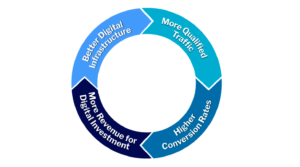
But the real power lies in the specific advantages that compound independently:
SEO Authority Compounds Exponentially
A firm that publishes authoritative content earns backlinks from legal publications and industry sources. Those backlinks improve search rankings. Better rankings generate more visibility. More visibility attracts more backlinks. And so on and so on.
Within 24 months, that firm dominates search results for their practice areas—not because they’re spending more, but because they built authority that competitors can’t quickly replicate.
LLM Training Creates Permanent Advantage
Large language models powering ChatGPT, Claude, and Google’s AI Overviews are training on today’s web content. Firms creating structured, authoritative content now are literally teaching AI systems to recommend them. By 2027, when your prospects routinely ask AI tools for attorney recommendations, these systems will favor firms whose content they trained on, creating a “first-mover moat” that latecomers simply cannot penetrate.
Talent Attraction Accelerates
Strong digital presence attracts better lateral candidates who see the firm as forward-thinking and growth-oriented. Those laterals bring expertise that enhances content quality. Better content strengthens digital presence. The cycle accelerates. Meanwhile, firms with weak digital presence watch top performers leave for competitors who “get it.”
Client Experience Improvements Compound
Superior digital user experience leads to higher client satisfaction, which generates more referrals, creating more opportunities to demonstrate expertise through case results and thought leadership. Each success strengthens the next.
Consider what happens in just three years:
- Year 1: Digitally advanced firm builds SEO authority and begins appearing consistently in top search results
- Year 2: Authority compounds as accumulated backlinks and content depth create substantial ranking advantages
- Year 3: AI tools begin favoring the firm’s content, next-generation buyers increasingly discover them through AI-powered research, and the competitive gap more than doubles
The advantage isn’t linear—it’s exponential.
When Digital Gaps Become Unbridgeable
Right now, firms can still recover through aggressive digital investment. The gap is visible but manageable. Strategic initiatives like a comprehensive SEO overhaul, accelerating answer-first structured content, and technical optimization, can close the distance. However, this requires investment and sustained commitment.
Many firms have convinced themselves they have more time. They don’t.
By the next couple of years, your competitors will have built substantial digital authority and established AI visibility advantages. Recovery will require even greater investment. Some firms will begin strategic pivots—merging with digitally stronger firms or abandoning practice areas where the digital gap has become too large. The firms that had “more time” in year one will face difficult choices.
By 2030, your competitors will dominate search rankings with authority that would require years to replicate. The investment required to catch up exceeds what most firms can justify, even when they finally recognize the problem. At this stage, firms face a binary choice: accept permanent second-tier status in their markets, or pursue merger/acquisition as the only viable path to digital competitiveness.
The Strategic Choice: 2026 Is Your Inflection Point
If you’re a CMO or managing partner reading this and feeling uncomfortable, you should be.
Will your firm be among the digital leaders who compound advantages, or the digital laggards who face exponentially harder recovery?
This is the year you decide.
Helpful resources
Discover the power of effective digital marketing.
Sign up to receive 9Sail’s exclusive content and tactical tips, focused on helping law firms grow.
9Sail takes your privacy seriously and will only use your personal information to deliver communications you have requested of us. You can change your preferences at any time.